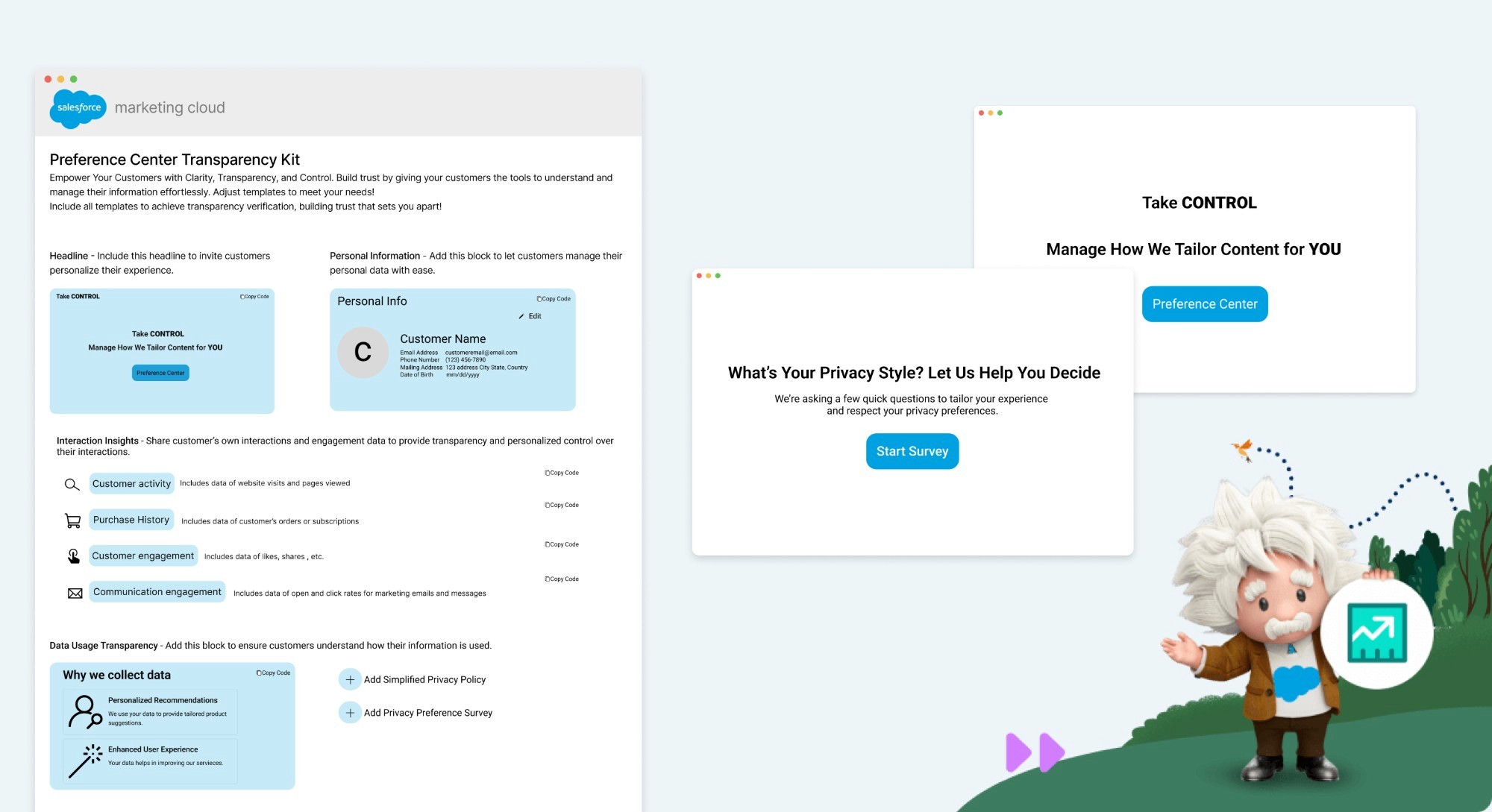
Preference Center Transparency Kit screen in Salesforce Marketing Cloud, with the Take Control and privacy style survey screens

SALESFORCE, MARKETING CLOUD

Designing for transparency in marketing

Designing for transparency in marketing

Design a new feature that empowers marketers to build strong brand affinity by demonstrating data transparency to end consumers.

Design a new feature that empowers marketers to build strong brand affinity by demonstrating data transparency to end consumers.

Selected as a top project by the Salesforce design team

ROLE

UX/UI Designer

UX/UI Designer

TIMELINE

November 2024

November 2024

TEAM

Roda Berhane,
Jackson Campbell

Roda Berhane,
Jackson Campbell

TOOLS

Figma, FigJam

Figma, FigJam

01 · OVERVIEW

Salesforce Marketing Cloud is a platform marketers use to manage customer data and reach their customers. Our team received this project directly from the Salesforce design team, and the brief was to design a new feature for Marketing Coud. Because its customers are marketers, the design had to work for two groups: tools that are easy for marketers to set up, and signals consumers can see and trust. Spotify is the example brand throughout.

Companies increasingly share how they use customer data.
How can Marketing Cloud help marketers do this well, so transparency builds brand affinity and trust with consumers?

Companies increasingly share how they use customer data.
How can Marketing Cloud help marketers do this well, so transparency builds brand affinity and trust with consumers?

02 · SOLUTION

Five features, one transparency kit

Five features, one transparency kit

Know you better,
and let the company know you

Know you better,
and let the company know you

An onboarding survey asks five questions about privacy preferences, values, willingness to share data, and privacy-related behavior.

An onboarding survey asks five questions about privacy preferences, values, willingness to share data, and privacy-related behavior.

Animated walkthrough of the onboarding privacy survey
  • Survey result screen: You are a Privacy Guardian, with data sharing recommendations
  • Survey result screen: You are a Selective Sharer, with data sharing recommendations
  • Survey result screen: You are a Trusting User, with data sharing recommendations
  • Survey result screen: You are a Confused User, with data sharing recommendations

Define your privacy style
with four archetypes

Define your privacy style
with four archetypes

Survey results place each person in one of four archetypes with distinct values, behaviors, and attitudes. Personalized recommendations and toggles adjust data sharing.

Survey results place each person in one of four archetypes with distinct values, behaviors, and attitudes. Personalized recommendations and toggles adjust data sharing.

All information in one page,
with control

All information in one page,
with control

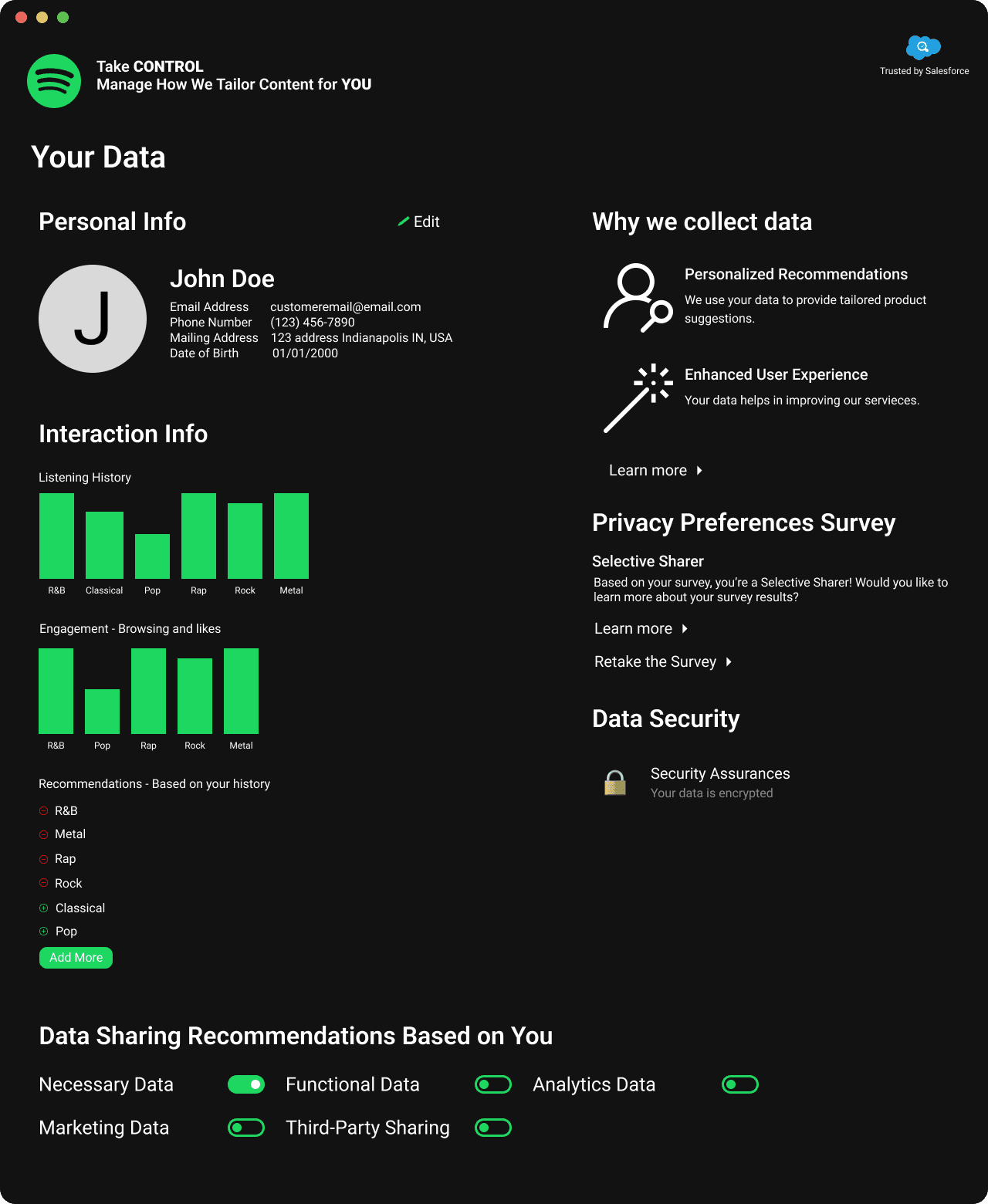
A Preference Center brings personal information, why data is collected, and derived insights together, with toggles for data sharing.

A Preference Center brings personal information, why data is collected, and derived insights together, with toggles for data sharing.

Preference Center for Spotify showing personal info, interaction info and data sharing toggles
Preference Center Transparency Kit in Salesforce Marketing Cloud

Customize using the transparency kit

Customize using the transparency kit

Salesforce provides a kit with instructions, so marketers can tailor the Preference Center to their brand by copying code.

Salesforce provides a kit with instructions, so marketers can tailor the Preference Center to their brand by copying code.

Building consumer confidence
through rewards

Building consumer confidence
through rewards

A badge appears on the login and sign-up pages of websites that meet strong privacy standards, building confidence before anyone shares data.

A badge appears on the login and sign-up pages of websites that meet strong privacy standards, building confidence before anyone shares data.

Trusted by Salesforce badge

03 · RESEARCH

Designing for two people at once

Designing for two people at once

Salesforce Marketing Cloud is built for marketers, but the people who feel the outcome are the consumers those marketers reach. Our client is not the end consumer, it is the marketing teams and companies. So every decision had two readers: the marketer who has to set it up, and the consumer who has to trust it.

Salesforce Marketing Cloud is built for marketers, but the people who feel the outcome are the consumers those marketers reach. Our client is not the end consumer, it is the marketing teams and companies. So every decision had two readers: the marketer who has to set it up, and the consumer who has to trust it.

That changed how I read the research. Trust and brand affinity only matter if a marketer can actually use a feature to earn them. And a transparency tool is only worth building if a consumer notices it and feels more comfortable sharing their data because of it.

That changed how I read the research. Trust and brand affinity only matter if a marketer can actually use a feature to earn them. And a transparency tool is only worth building if a consumer notices it and feels more comfortable sharing their data because of it.

3.1

Research goals and matching methods

Research goals and matching methods

See how consumers feel about the way their data is handled

See how consumers feel about the way their data is handled

→

Secondary research (Pew)

Secondary research (Pew)

Understand what makes people trust a brand

Understand what makes people trust a brand

→

Literature review

Literature review

Find out what people look for in a privacy policy

Find out what people look for in a privacy policy

→

Interviews

Interviews

3.2

What consumers say about their data

What consumers say about their data

Secondary research: Pew Research Center

I first looked at consumers. People are increasingly concerned about how their data is handled, yet most still do not read privacy policies. That gap is what a quick, visible signal can close.

I first looked at consumers. People are increasingly concerned about how their data is handled, yet most still do not read privacy policies. That gap is what a quick, visible signal can close.

How often do people skip reading privacy policies?

How often do people skip reading privacy policies?

56%

Frequently agree without reading

Everyone else

Source: Pew Research Center, U.S. adults

81%

81%

CONCERNED ABOUT COMPANIES

of U.S. adults are concerned about how companies use the data they collect.

67%

67%

LITTLE TO NO UNDERSTANDING

say they understand little or nothing about what companies do with that data.

Companies and the government, side by side

Companies and the government, side by side

Concerned about how they use the data

Companies

81

Government

71

Understand little to nothing about it

Companies

67

Government

77

% of U.S. adults. Source: Pew Research Center

3.3

What makes people trust a brand?

Literature Review

Next, I turned to the literature. Companies share how they use customer data because they want strong brand affinity, and transparency and trust are what build long-term loyalty and meaningful connections with an audience.

Next, I turned to the literature. Companies share how they use customer data because they want strong brand affinity, and transparency and trust are what build long-term loyalty and meaningful connections with an audience.

For what trust is made of, I used Mayer, Davis, and Schoorman’s (1995) model, which names ability, benevolence, and integrity as the key components. A brand has to show all three, not just claim them.

For what trust is made of, I used Mayer, Davis, and Schoorman’s (1995) model, which names ability, benevolence, and integrity as the key components. A brand has to show all three, not just claim them.

Trust model: ability, benevolence and integrity feed into trust, and the trustor’s propensity moderates the link

Mayer, R. C., Davis, J. H., & Schoorman, F. D. (1995). An integrative model of organizational trust. Academy of Management Review, 20(3), 709-734.

“The trustor’s propensity plays

a crucial role in building trust relationships.”

“The trustor’s propensity plays

a crucial role in building trust relationships.”

How willing people are to trust is shaped by personality and culture.

How willing people are to trust is shaped by personality and culture.

3.4

What people look for before sharing data

What people look for before sharing data

Interviews

To see what people actually look for, I interviewed people with limited knowledge of privacy policies. Each one picked their top five elements from ten standard privacy policy categories. These five came out on top.

To see what people actually look for, I interviewed people with limited knowledge of privacy policies. Each one picked their top five elements from ten standard privacy policy categories. These five came out on top.

TOP FIVE CATEGORIES

01

Purpose of data collection

Purpose of data collection

Why data is collected, and the legal basis for processing it.

02

Data security measures

Data security measures

How data is protected, and how users are told about breaches.

03

Data collection practices

Data collection practices

What is collected, and how it is gathered.

04

Data sharing and disclosure

Data sharing and disclosure

When and why data is shared with third parties or authorities.

05

User rights

User rights

How people access, correct, delete or opt out of their data.

Together they cover what people most want to know before sharing data: why it is collected, how it is protected, what is collected, who it is shared with, and what control they keep.

Together they cover what people most want to know before sharing data: why it is collected, how it is protected, what is collected, who it is shared with, and what control they keep.

I used Spotify as the example brand to keep both sides concrete. The marketer is asking, how do I show my data practices without adding work or risk? The consumer is asking, can I tell, in a few seconds, whether this brand handles my data well? The trust badge came out of holding those two questions together, rather than answering one at a time.

I used Spotify as the example brand to keep both sides concrete. The marketer is asking, how do I show my data practices without adding work or risk? The consumer is asking, can I tell, in a few seconds, whether this brand handles my data well? The trust badge came out of holding those two questions together, rather than answering one at a time.

04 · IDEATION

FOR MARKETERS

Each customer’s data is a resource

Each customer’s data is a resource

It shows who their customers are, what they care about, and how to reach them.

↔

FOR CONSUMERS

That same data belongs to a person

That same data belongs to a person

Their privacy has to be protected.

The two needs pull in opposite directions, and a feature that only serves one of them fails the other.

The two needs pull in opposite directions, and a feature that only serves one of them fails the other.

So we started ideation with one question:

?

How might we encourage end consumers to share their data with marketers?

How might we encourage end consumers to share their data with marketers?

People are concerned about their data and rarely read privacy policies, so asking harder or explaining more would not work. If people feel sure about a brand before they share, and stay in control after they share, they are more willing to take part. That gave us two directions to explore.

People are concerned about their data and rarely read privacy policies, so asking harder or explaining more would not work. If people feel sure about a brand before they share, and stay in control after they share, they are more willing to take part. That gave us two directions to explore.

DIRECTION 1 · CONFIDENCE BEFORE SHARING

A badge, not a grade

A badge, not a grade

To build confidence before anyone shares anything, I wanted a reward without a grading authority. The Michelin Star was the reference: a badge created by Salesforce and shown on login pages to build trust and reputation.

DIRECTION 2 · CONTROL WHILE SHARING

Four archetypes

Four archetypes

To keep people comfortable while they share, we looked at how differently people feel about privacy, so data-sharing recommendations match what a person values instead of treating everyone the same.

Privacy Guardian illustration: two people holding a large shield with a check mark

Privacy Guardian

Privacy Guardian

Absolute control over personal data and minimal exposure.

Selective Sharer illustration: a person working on a laptop surrounded by charts

Selective Sharer

Selective Sharer

Balancing privacy with the convenience of sharing data.

Trusting User illustration: a person holding a tablet connected to social media icons

Trusting User

Trusting User

Convenience and functionality over privacy concerns.

Confused User illustration: a person with question marks and a light bulb

Confused User

Confused User

Wants to do the right thing but struggles with privacy concepts.

TOGETHER, THESE IDEAS ANSWER THE QUESTION FROM BOTH SIDES

MARKETERS

Get consumers who are more willing to share

Get consumers who are more willing to share

CONSUMERS

Get clear signals and real control over their data

Get clear signals and real control over their data

05 · REFLECTION

The Salesforce design team selected this as a top project, but what stayed with me most was how complex a real problem gets when two groups have to be served at once. Our client was the marketer, yet the design only worked if a consumer noticed it and felt more comfortable sharing their data.

The research also changed how I think about trust. It is not just something a brand earns by saying the right things, because a person's own willingness to trust shapes how they respond. That is why we focused on small, visible signals like a badge on a login page, and I now start every project by asking who a feature is really for.